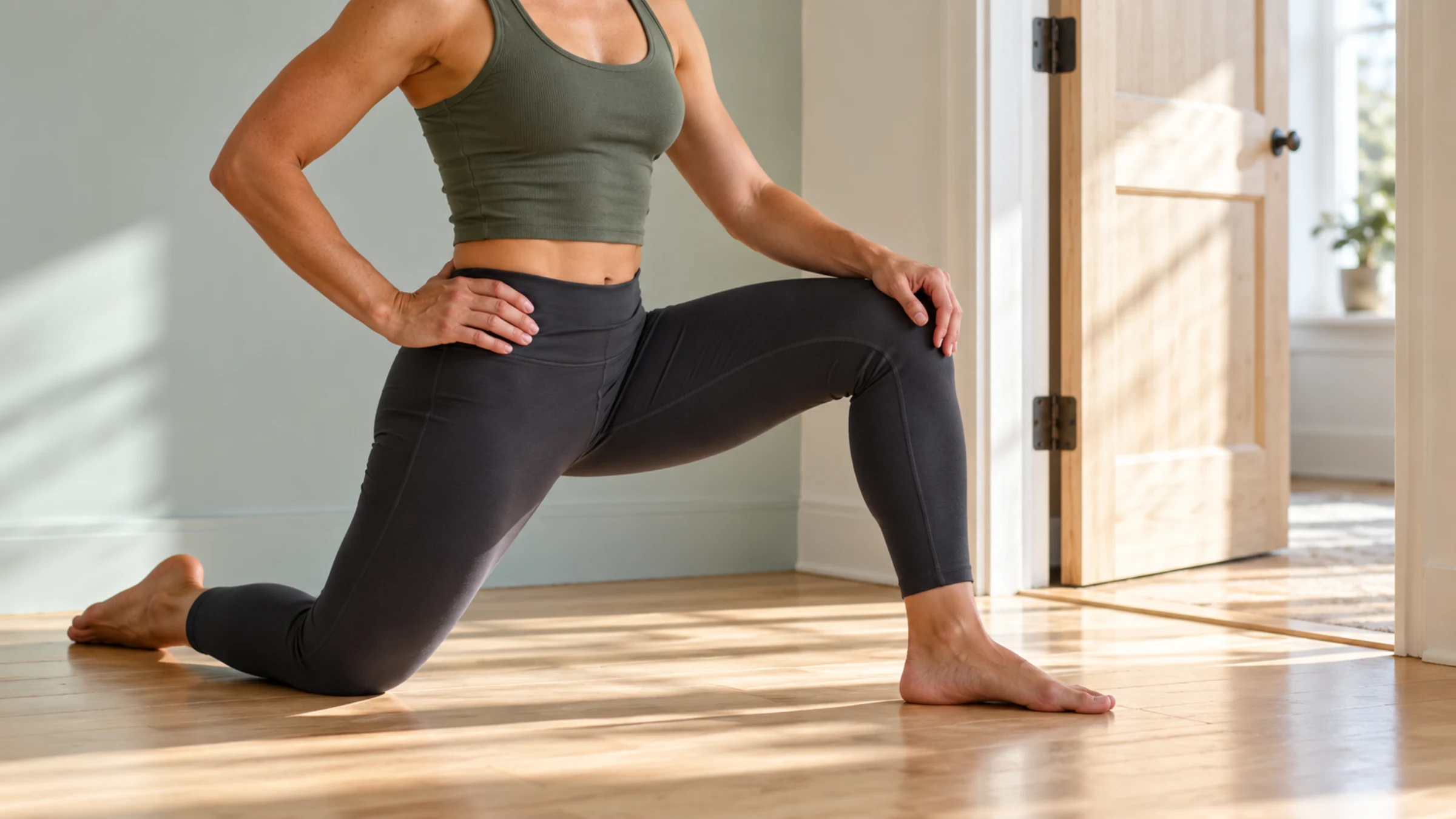
Prerequisites
A door that swings freely on a loose frame is not flexible in a useful way; it is a hazard. The hinge, the swing you command, and the wall around it are three separate mechanical jobs.
Most people lump all three under one word: flexibility. When hips feel tight, someone stretches every morning for six weeks and stays tight. Someone else stretches for years, flattens their palms to the floor, and still tweaks their back picking up a pencil.
Both problems come from treating three different capacities as if one tool fixes all of them. Having plenty of one without the others is usually why a joint breaks down.
The door and the frame
Picture an interior door mounted in a wall. Three things must work for that door to do its job.
First, the hinge needs clearance to swing without jamming. That is flexibility: the raw passive range of motion available at a joint. Passive range is how far an outside force, like gravity, a partner, or a strap, moves the joint while your muscles stay relaxed. It only tests whether the physical space exists, not whether you can control it.
Second, the door needs a handle so you can swing it open and stop it wherever you want. That is mobility: the active range of motion you can reach and control using your own muscles. A door that only moves when caught in a draft is out of control. Mobility requires your muscles to produce force through that entire arc.
Third, the frame holding the hinges must be anchored into the wall studs. That is stability: holding a joint steady and controlling movement under load while forces shift and surrounding body parts move. If the frame wobbles in the drywall every time you turn the handle, the door is a hazard.
A gymnast doing the splits has extraordinary flexibility. A gymnast holding a motionless handstand has extraordinary stability. Doing one tells you nothing about the other.
Across the body, joints balance these demands by alternating duties: mobile joints like hips and ankles sit right next to stable joints like knees and the lower back.
- Flexibility: What it is: passive range of motion. What test shows it: how far an outside force moves the relaxed joint. How you train it: passive stretching, contract-relax stretches.
- Mobility: What it is: active range under control. What test shows it: how far you move the joint using only your muscles. How you train it: controlled articular rotations, loaded end-range lifts.
- Stability: What it is: control under load. What test shows it: how well you resist unwanted joint movement. How you train it: isometric holds, anti-rotation drills, loaded carries.
The Joint Centration Interlocking Triad
Joint integrity is not a single attribute. It is the dynamic convergence of tissue extensibility (flexibility), neuromuscular active range (mobility), and motor control to resist shear (stability).
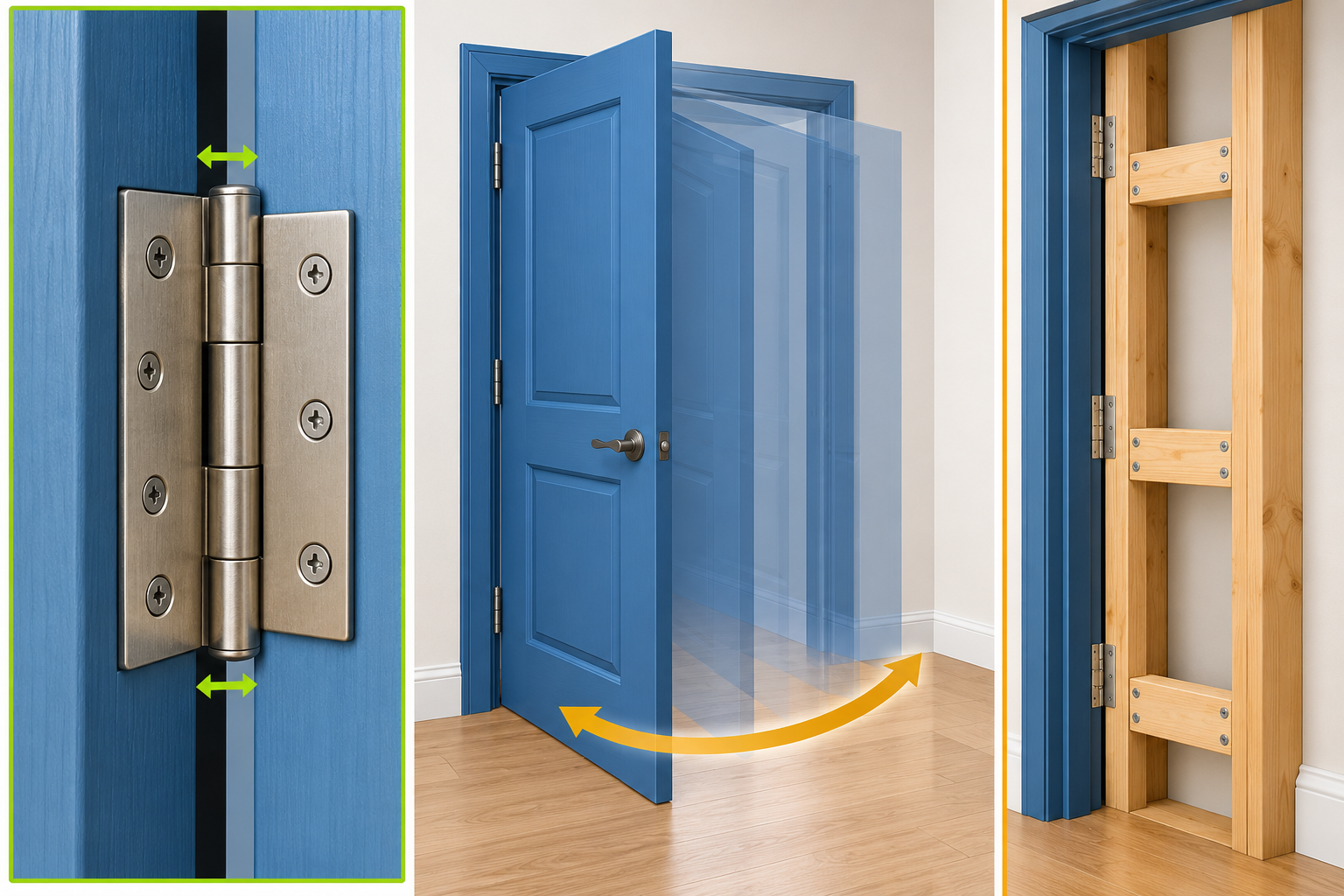
The Loose Doorframe
High flexibility with zero motor stability. Ligaments stretch, but muscles fail to centrate the humeral or femoral head, resulting in labral fraying and micro-subluxation.
The Frozen Hinge
Muscles brace aggressively, but passive tissue extensibility is completely lost. Forces cannot be absorbed through joint travel, transferring destructive shear to adjacent discs.
Centrated Autonomy
The joint achieves full anatomical range under active motor control. Equal capsular tension on all sides ensures the instantaneous axis of rotation stays centered.
Flexibility: passive range and its real limits
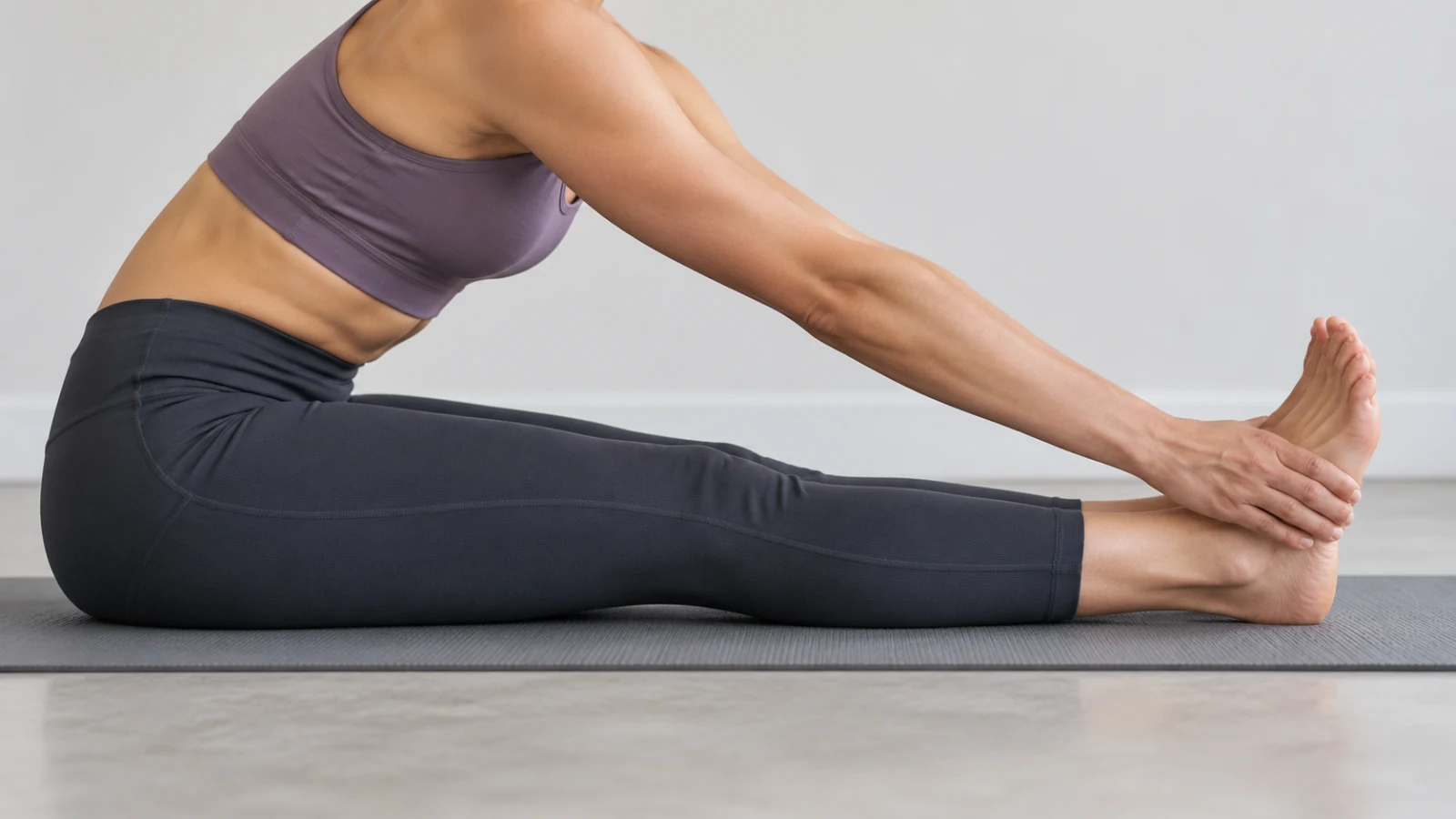
Flexibility is what a stretch tests: how far a joint moves when an outside force does the work while your muscles relax. When you touch your toes, gravity pulls your torso down. That test does not check whether your muscles can pull you down there on their own, or absorb an impact while folded in half.
Flexibility has real value. Joints need baseline clearance so shortened tissue does not block movement. If an old injury leaves your hip unable to bend past eighty degrees, you cannot squat or tie your shoes without rounding your spine. Passive stretching addresses that restriction. Like the stress, recovery, and adaptation loop from Guide 1, tissues adapt to regular, sustained tension by gradually allowing greater length.
Problems start when flexibility is chased as an end in itself. Passive range without muscular strength leaves a joint free to wander into positions you cannot control.
This is why loose, bendy people get hurt so often. They have hypermobility, a condition where joints move past normal anatomical limits because ligaments and connective tissues are naturally lax. Ligaments are fibrous bands connecting bone to bone that act as passive safety brakes against dislocation. When those brakes are loose, the joint lacks built-in mechanical stops.
Stretching loose ligaments makes the problem worse. It expands the range your muscles cannot police. Extra range without matching control is not an asset. It is an unmonitored zone where cartilage wears away and joints slip out of alignment under load.
Mobility: the range you actually own
Mobility is the slice of your flexible range that you can enter, control, and exit using only your own muscular effort.
Your mobility is always smaller than your flexibility. Lie on your back and have a partner lift your straight leg toward the ceiling. They might push it to ninety degrees before feeling resistance. That is your passive flexibility. Now lower the leg and lift it using only your hip muscles. Most people stop at seventy degrees.
The space between those two numbers is the control gap: physical territory your joint can reach, but where your nervous system has built no strength to direct movement. If a stumble or a heavy weight throws your joint into that gap, you have no active strength to pull yourself out or protect the joint.
Mobility training closes that gap. Instead of relaxing into a passive stretch, it demands active muscular force at the edges of your range.
This takes specific tools. Controlled articular rotations use slow, active joint circles carved out under internal tension. Loaded mobility drills sink into deep positions under light weight while actively pulling down and driving back up under control. The goal is teaching your nervous system to produce force across the entire arc.
Key idea
If you can only reach a position when someone pushes you there, you do not own that range. You visited it. If you cannot get yourself out of that position under your own power, you have no business loading it.
Stability: control under load while things move
Stability is the most underrated of the three capacities because it does not make for flashy party tricks. A high kick looks athletic. Stability looks like an athlete holding a clean posture while chaotic forces try to knock them over.
Stability is the capacity of muscles, tendons, and the nervous system to keep a joint centered and secure under load while forces shift and adjacent body parts move.
The shoulder is the clearest example of why this matters. It has the greatest range of motion of any joint in the body, but that freedom comes at the direct expense of bony security. The joint is built like a golf ball on a shallow plastic tee: the upper arm bone rests against a flat socket on the shoulder blade that offers almost no bony lip to hold it in place.
Because bones cannot hold the arm in, your muscles have to do it. That is what the rotator cuff is for. The rotator cuff is a group of four small, deep muscles and their tendons that wrap around the shoulder joint, pulling the ball of the upper arm bone firmly into the center of the socket.
A shoulder with huge flexibility and a weak rotator cuff is a liability. Every time you press overhead or reach behind you, the ball slides off-center, grinding cartilage and pinching tendons. Giving that shoulder more stretches just adds slack to a loose system. It needs stability training: isometric holds, drills that force you to resist unexpected nudges, and loaded carries that teach the rotator cuff to center the joint under pressure.
The hip is the opposite architecture: a deep ball-and-socket structure built like a baseball seated inside a leather glove. That deep socket gives the hip substantial stability from the start. Even so, the surrounding hip muscles must still actively stabilize the pelvis so forces do not twist the joint out of line while walking, running, or squatting.
The Joint-by-Joint Kinetic Alternating Chain
Human movement is an alternating stack: a mobile joint sits beneath a stable joint, which sits beneath a mobile joint. When a mobile joint loses its freedom, the stable joint above is forced to move, triggering structural breakdown.
"Loose" and "tight" are not diagnoses
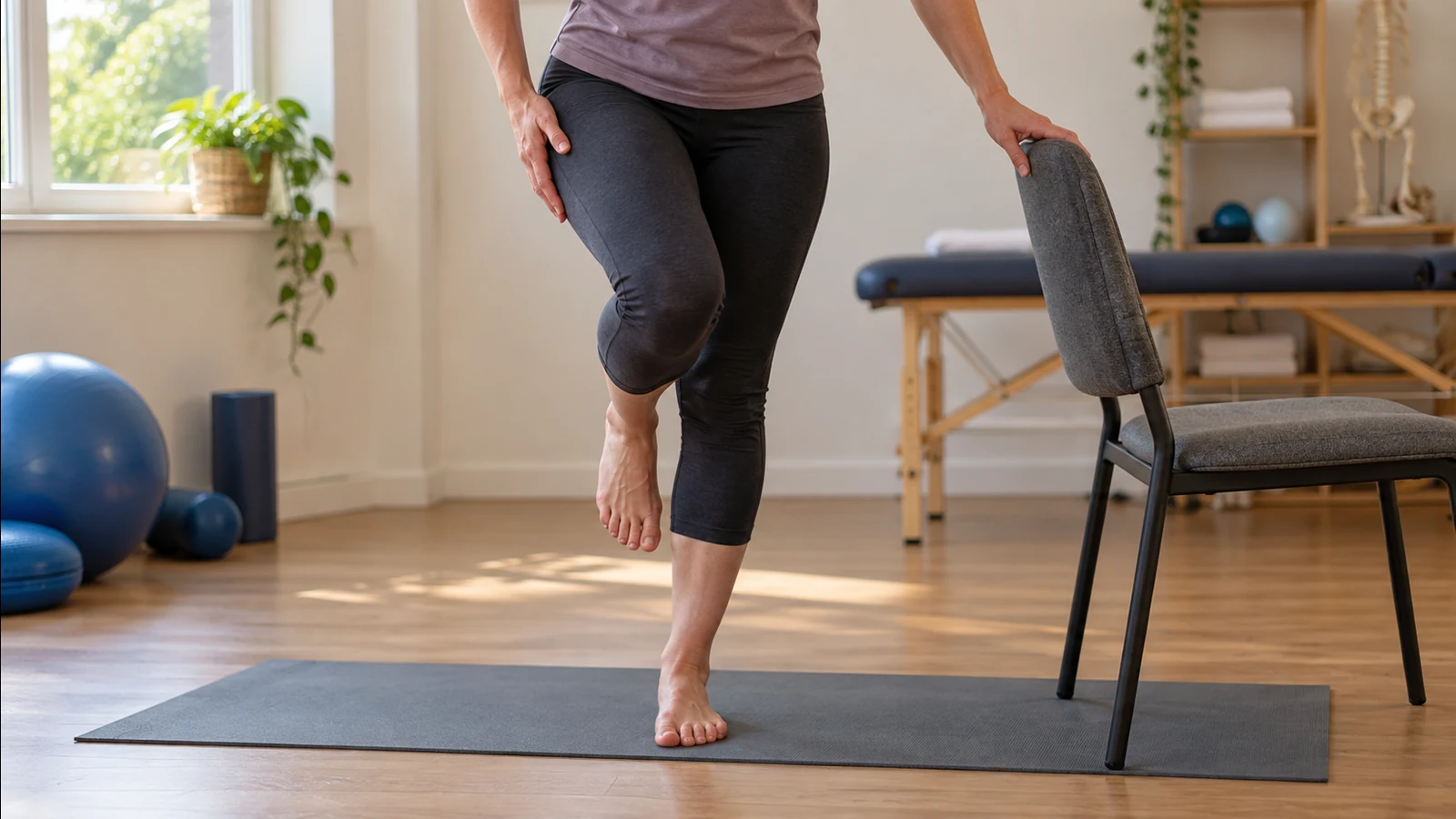
When people describe their bodies, their most frequent complaint is feeling tight. Almost everyone assumes tightness is a physical diagnosis with one cure: stretch until the feeling stops.
That assumption fails because tightness is a sensation generated by your nervous system, not a measurement of muscle length. That sensation points to one of two different physical realities.
Sometimes tightness is true structural shortening. Muscle fibers and connective tissue have physically shortened over months of disuse, like an ankle locked in a walking cast for six weeks. Here, the hinge is genuinely stuck, and passive stretching combined with progressive loading is the right tool.
Far more often, tightness is a protective neurological brake. When your brain senses that a joint lacks stability, it refuses to let you move freely into ranges you cannot defend. The nervous system increases baseline muscle tension to clamp the joint down like an emergency brake.
This is why stretching tight hips or hamstrings over and over fails to provide lasting relief. Sitting in a chair all day leaves your hip stabilizers inactive. When you stand up, your pelvis lacks active muscular support. Your nervous system detects that instability and orders your hamstrings and hip flexors to contract, holding the pelvis steady with continuous tension.
Stretching that protective tension away removes the only temporary stability the joint had left. Your brain senses the danger and clamps the muscle down harder a few hours later. You cannot solve a stability problem with a stretching tool. The door was never jammed; the frame was wobbling, and your nervous system threw a latch across the hinge to keep the wall from collapsing.
You cannot solve a stability problem with a stretching tool.
Putting the door back together
A functioning joint needs the whole system working at once:
Flexibility gives the hinge clearance to swing.
Mobility gives you the muscular power to steer the door.
Stability keeps the frame anchored while forces pass through it.
A joint needs all three in balance. Chasing flexibility alone leaves you with empty range you cannot defend. Building strength without baseline flexibility leaves you trapped inside a stiff, limited frame.
The next time a joint feels tight, do not default to passive stretching. First ask whether you are truly missing range or simply missing control over the range you already have. Own the range you possess, train the frame to hold firm under load, and give your nervous system a reason to trust the swing.
Educational content only. It is not individual medical advice.