
Prerequisites
The Biological Bottom Line
Injured, aging, and fatigued cells suffer from destabilized mitochondrial inner membranes. Cytochrome c detaches from cardiolipin, causing electrons to leak and spew reactive oxygen species (ROS).
SS-31 (Elamipretide) is a tetrapeptide that selectively targets and binds cardiolipin on the inner mitochondrial membrane, restoring cristae curvature and shutting off the electron leak.
MOTS-c is a 16-amino-acid peptide encoded directly inside mitochondrial DNA that translocates into the cell nucleus to stimulate AMPK, pull glucose into muscle cells, and enhance metabolic flexibility.
A cell cannot remodel structural collagen if its energy currency (ATP) is depleted. Restoring mitochondrial flux is the prerequisite for all soft tissue repair.
Longevity marketing treats cellular energy as a single knob, as if tired mitochondria were one stock-keeping unit. Mitochondria are the microscopic compartments inside cells that convert food into usable energy. Inside them, cells produce ATP (adenosine triphosphate), the primary chemical fuel spent to power physical work and repair tissue.
Online carts routinely bundle two entirely different scientific categories into the same order.
The first category consists of mitochondrial-derived peptides, which are short chains of amino acids encoded directly inside the mitochondrion's own DNA that travel outward to signal the rest of the cell. MOTS-c is one specific mitochondrial-derived peptide triggered by metabolic stress.
The second category centers on NAD+ (nicotinamide adenine dinucleotide). NAD+ is a coenzyme, a non-protein helper molecule required by cellular enzymes to carry out chemical reactions. Because whole NAD+ cannot easily enter cells directly, supplement makers sell precursors, which are raw chemical building blocks that cells convert into finished molecules. Two common precursors are NMN (nicotinamide mononucleotide) and NR (nicotinamide riboside).
Bundling MOTS-c and an NAD+ precursor suggests they fix the same problem. They do not.
The Spark Plug and the Fuel Additive

An engine can have a full tank of fuel and still misfire on the first hill. The fuel gauge reads full, but the spark never lands. Pouring more fuel additive into a cylinder with a fouled spark plug is not the same repair as replacing the plug.
Mitochondrial peptides and NAD+ precursors describe the same engine, but they address different failure modes. Peptides belong to the spark plug conversation: structural stabilization of internal membranes, organelle-to-nucleus signals, and physical hardware. NAD+ precursors belong to the fuel additive conversation: electron shuttling, redox chemistry, and cofactor supply. Mixing both in one checkout cart blurs categories on purpose.
In Guide 4, we outlined the core communication chain: signal, receptor, and response. A signal binds to a surface receptor, triggering a response inside the cell. SS-31, known clinically as elamipretide, is a synthetic tetrapeptide that enters the cell and physically stabilizes mitochondrial membranes. SS-31 is the odd cousin of this family because it does not bind to a surface receptor. It acts directly inside the internal membrane architecture. If that hardware is broken, extra electron carriers will not rebuild the engine block.
SS-31 Cardiolipin Docking & Electron Leak Prevention
Cardiolipin Binding
SS-31 selectively integrates into cardiolipin, the unique cone-shaped phospholipid that gives cristae membranes their extreme curvature and holds Complex I–IV assemblies in tight alignment.
Cytochrome c Anchor
Prevents Cytochrome c from detaching from the inner membrane. Halts the electron leakage that generates toxic reactive oxygen species (ROS) and stops apoptotic caspase cascades.
ATP Synthase Torque
Restores the intact proton gradient across the inner membrane (-180 mV). High proton motive force drives the rotary motor of ATP synthase to restore cellular cellular energy flux.
Hardware Versus Fuel in the Inner Membrane
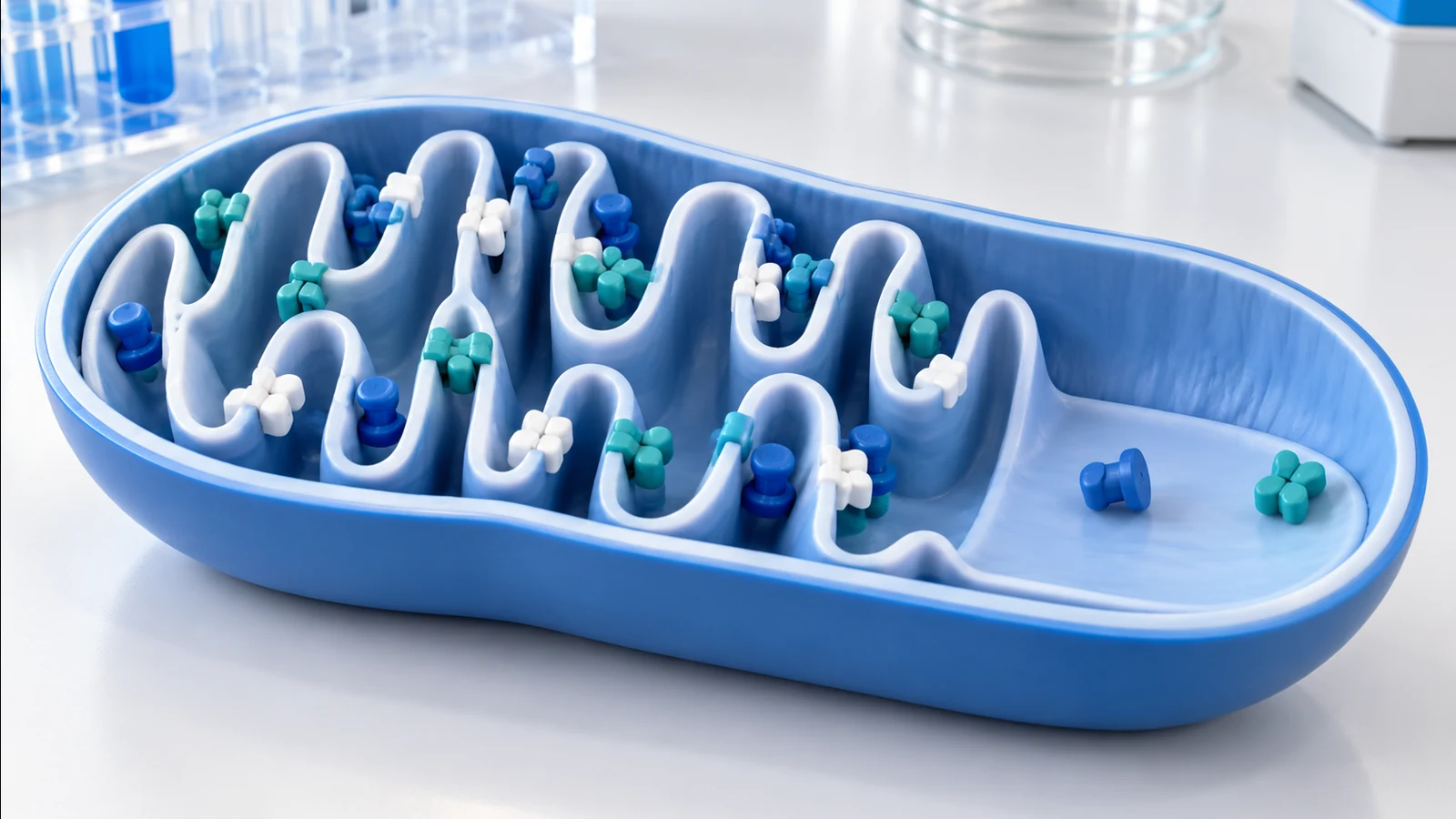
Mitochondria convert food into ATP using the electron transport chain, a series of protein complexes that transfer electrons like a bucket brigade to build an energy gradient.
This machinery sits within the inner membrane, the interior lipid barrier of the mitochondrion. That membrane folds into deep ridges called cristae, expanding the surface area available to generate energy.
Holding the transport complexes in working clusters is cardiolipin, a specialized phospholipid with four fatty acid tails found almost exclusively in the inner membrane. Cardiolipin acts as physical scaffolding, keeping the protein assemblies tightly aligned.
When oxidation damages cardiolipin, cristae flatten and the complexes drift apart. Electrons slip out of sequence and collide with oxygen, generating reactive oxygen species (ROS), which are unstable, chemically reactive oxygen fragments that damage cellular structures.
When membrane hardware unravels, electron leakage rises, oxidative noise increases, and ATP production drops. Pouring more fuel into a leaking chain does not restore energy. It simply forces more current through a frayed wire.
The Cofactor Shuttles: NAD+, Sirtuins, and PARPs
NAD+ acts as an electron shuttle, delivering energy from food to the electron transport chain. It also acts as a consumable fuel for enzymes that maintain cellular health.
Two main enzyme families spend NAD+:
Sirtuins are regulatory enzymes that consume NAD+ to modulate gene expression, reduce stress, and guide metabolic adaptations.
PARPs (poly-ADP-ribose polymerases) are repair enzymes that consume large amounts of NAD+ to locate and fix damaged DNA.
Studies in aging animal tissues show lower baseline NAD+ levels across certain organs. That is a genuine research theme, not evidence that fatigue is a simple NAD+ deficiency that an online brand can cure with a pill.
Key idea
When a cell faces chronic stress or tissue injury, PARPs and sirtuins spend NAD+ rapidly, leaving less available to shuttle electrons for energy production. A standard commercial test panel cannot determine whether low NAD+ reflects insufficient precursor supply, excessive enzyme spending, or an inner membrane leaking electrons. The biochemical steps converting NMN and NR into NAD+ are real science. The claim that swallowing them cures exhaustion is the product.
The Named Peptides: Signals and Stabilizers

Mitochondrial peptides operate in a different domain from cofactors: they handle signaling and structural stabilization.
MOTS-c is encoded directly within mitochondrial DNA. In preclinical models, metabolic stress prompts MOTS-c to signal the cell nucleus, where it stimulates AMPK (adenosine monophosphate-activated protein kinase), the cell's master energy sensor. Activating AMPK promotes glucose uptake and fatty acid oxidation, improving metabolic flexibility, the capacity to switch smoothly between burning fats and carbohydrates.
Longevity clinics label MOTS-c an exercise mimetic. That is marketing language. A chemical signal triggered by exercise is not the exercise itself. In Guide 2, we established that healing is a sequence: tissue remodeling requires real mechanical load. A vial cannot replace physical movement. While animal data show metabolic benefits, human lifestyle trials remain thin.
Humanin is another mitochondrial-derived peptide, identified as a survival signal that protects cells from premature death under stress. It is a compelling discovery, but not a reason to overlook basics like sleep, iron, thyroid status, or local joint mechanics.
Elamipretide (SS-31) is a synthetic tetrapeptide that enters the inner mitochondrial membrane to dock alongside cardiolipin. By supporting cardiolipin, it helps maintain cristae curvature and prevents electron leakage. Elamipretide is currently in clinical development for genetic mitochondrial myopathies and heart failure. A formal drug-development program demonstrates real pharmacology, but it is not a lifestyle license for gym recovery.
MOTS-c Retrograde Nuclear Translocation & Glucose Routing
mtDNA 12S rRNA
Encoded directly within the short open reading frame of mitochondrial DNA (mtDNA) rather than nuclear chromosomes. Synthesized inside the mitochondrial matrix in response to physical exertion.
Nuclear Translocation
Under metabolic demand, MOTS-c translocates from the cytoplasm into the cell nucleus, binding to antioxidant response elements (ARE) and activating the master cellular energy sensor (AMPK).
GLUT4 Influx
AMPK activation mobilizes GLUT4 glucose transporter vesicles to fuse with skeletal muscle plasma membranes, pulling circulating glucose into working muscle fibers independent of insulin.
MOTS-c functions as a true retrograde messenger: the power plant (mitochondria) reporting back to the corporate headquarters (cell nucleus) to demand fuel reorganization. This restores metabolic flexibility and fuels deep connective tissue remodeling.
SS-31 (Elamipretide)
The Inner Membrane Mechanic. Docks directly into cardiolipin. Tightens cristae curvature, prevents Cytochrome c detachment, and halts reactive oxygen species (ROS) leaking at the source.
MOTS-c (mtDNA Peptide)
The Exercise Mimetic. Retrograde signaling peptide that activates AMPK, pulls glucose into skeletal muscle via GLUT4, and overcomes metabolic rigidity in fatigued or insulin-resistant athletes.
Combined Bioenergetic Reset
The Cellular Overhaul. Restores high-efficiency ATP synthesis (SS-31) while optimizing fuel delivery to working tissues (MOTS-c), recharging the biological battery required for tissue remodeling.
Category Hygiene and the Clean Separation
Credibility in this space depends on category hygiene: naming biological mechanisms accurately instead of bundling them for sale.
When a longevity cart combines MOTS-c, an NAD+ infusion, a repair peptide, and a growth hormone secretagogue, the customer hears a single mitochondrial protocol. Biology hears four distinct conversations: an electron cofactor, an intracellular stress message, a local repair signal, and a pituitary request.
In Guide 7, we saw that GLP-1 receptor agonists govern metabolic signaling through distinct endocrine pathways. Mixing cofactors and peptides into one generic basket confuses biology with commerce.
The Three Categories in the Longevity Cart:
- Cofactor and precursor supplies (NAD+, NMN, NR): Biochemical fuel shuttles that support energy production and enzyme consumption, but cannot reconstruct damaged membranes.
- Mitochondrial-derived signals (MOTS-c, humanin): Natural genetic messengers produced inside the organelle that coordinate stress responses, supported mainly by preclinical data rather than human lifestyle trials.
- Membrane-stabilizing pharmaceutical candidates (SS-31 / elamipretide): Synthetic compounds that physically anchor cardiolipin in failing tissues, studied in clinical drug trials rather than fitness protocols.
The categories do not mix.
Plain Answers to Common Questions
Can MOTS-c replace physical training? No. A stress signal without physical stress is an empty slogan. Movement generates mechanical load, fluid flow across joint cartilage, neuromuscular activation, and cardiovascular adaptation. An injected signal cannot build those structural adaptations.
Is delivery format the whole debate for NAD+? Whether NAD+ is delivered through an intravenous drip, an injection, or an oral precursor, it remains the same cofactor story. Clinics claim infusions are superior, but "better" is a marketing claim. The key pattern is a brief lift followed by a return to baseline within forty-eight hours. That transient surge reflects cofactor availability, saline hydration, or placebo rest. It is not structural membrane repair.
Does elamipretide prove the class is ready for lifestyle use? No. A clinical drug program for severe mitochondrial genetic disease is not a lifestyle license for gym fatigue. Clinical trials treat defined pathology; boutique wellness borrows medical terminology to sell unverified compounds.
Where does inflammation fit in? In Guide 3, we showed that inflammation is not the enemy; it is the necessary biological process that repairs damaged tissue. Chronic cellular inflammation causes PARPs to consume NAD+ rapidly. Adding precursors without addressing the underlying driver of tissue injury simply fuels an ongoing fire.
What about gray market sourcing? Many longevity compounds, including MOTS-c and research-grade SS-31, are sold online without prescription oversight. In Guide 10, we examine the legal status, purity risks, and supply chain realities of purchasing unregulated peptides.
The Tank Was Never the Plug
Name the category before naming the claim.
The fuel tank and the spark plug are separate components of the same engine. NAD+, NMN, and NR represent coenzymes and raw materials that replenish electron shuttles and feed repair enzymes. MOTS-c and humanin are mitochondrial-derived signals with thin human performance evidence. SS-31 and elamipretide belong to formal pharmaceutical research aimed at stabilizing physical membranes in severe disease.
A short surge in cellular cofactors cannot rebuild an unravelling, leaky inner membrane. Online checkouts will continue to bundle these products into a single shopping bag. The categories do not mix.
Educational content only. It is not individual medical advice.