
Metabolic Health · Diagnostics · Clinical Architecture
Why Your Labs Look Normal While Your Immune System Is in Overdrive
A green checkmark answers whether an organ is in crisis. It does not answer every question about immune activity, thyroid, metabolism, or why a joint fades in 48 hours.
A patient sat across from me with a two-inch folder of lab printouts.
Every page had neat columns, green checkmarks, and numbers sitting cleanly between two brackets.
The send-off from her doctor: “Good news. Your blood work is completely normal. You’re healthy. Sleep more. Manage your stress.”
Then she asked the only question that mattered.
“Sean, if I’m so healthy, why do my hands ache every morning? Why am I exhausted by 2 p.m.? Why does it feel like my body is constantly fighting something?”
She was not crazy. She was not making it up. She had already done the responsible thing. She got the labs.
The problem was narrower: those labs were tested for a narrower job than the one she was asking them to do.
A normal range is a comparison, not a diagnosis
Most people treat a lab range like a definition of health.
Inside the brackets: good. Outside: sick.
That is not how a reference interval is built. A conventional interval is commonly the central 95% of a defined reference population: values between the 2.5th and 97.5th percentiles. Statistical description. Not a complete health verdict. CLSI’s terminology uses that central-95% definition.
People being tested are not automatically a perfectly healthy reference population. You also cannot assume every range was built from a waiting room full of tired, sick, medicated patients. The reference population and the lab’s method matter.
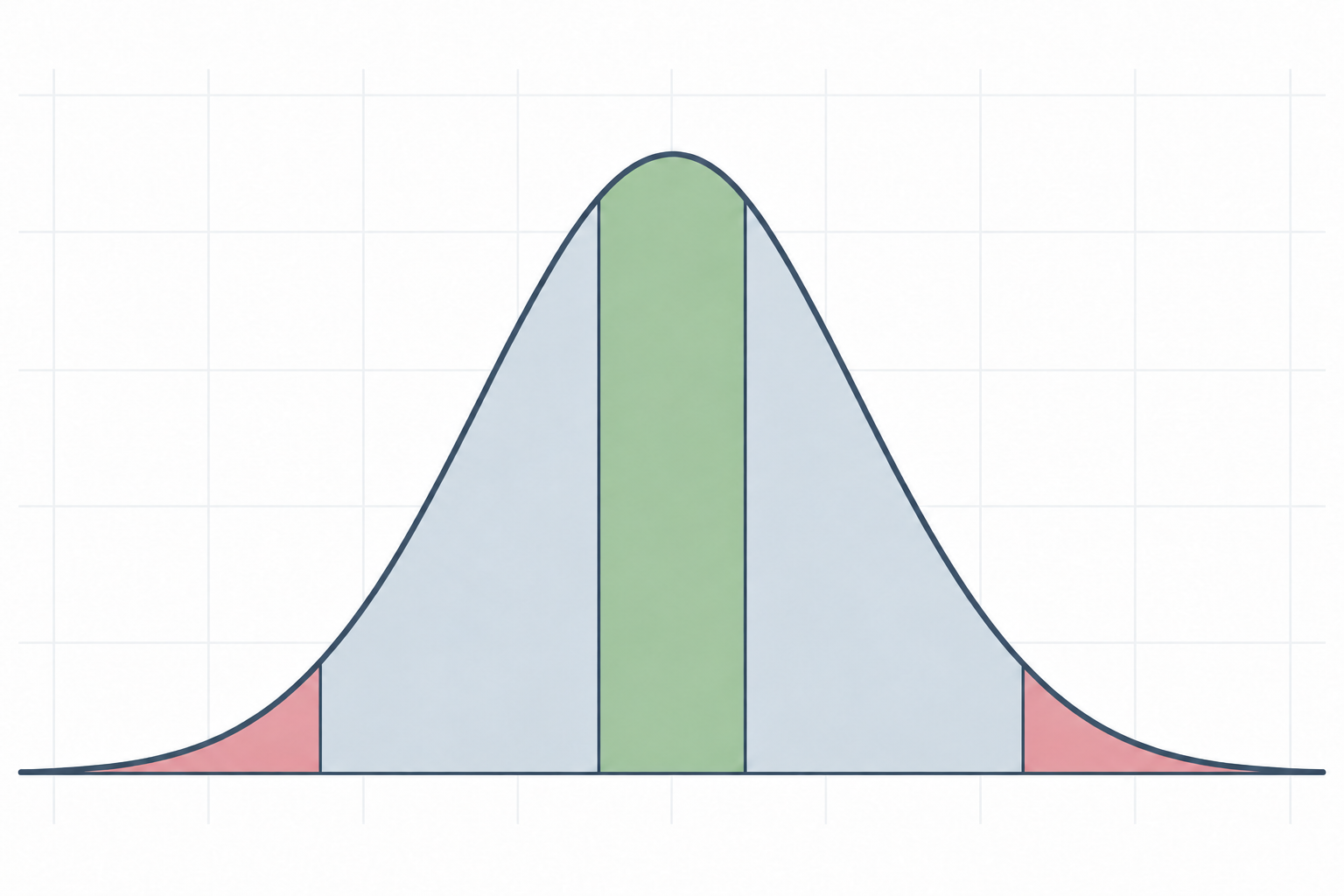
Left tail boundary
Right tail boundary
CRISIS
ORGAN
FAILURE
Outside the central 95 percent
Zero tissue degradation
Normal TSH, High Antibodies
Normal Sugar, 4x Insulin
Matching a comparison interval does not prove your immune system, thyroid, or joints are doing their job.
Those ranges are useful at catching a crisis:
- Is the liver in acute failure?
- Are the kidneys shutting down?
- Is blood sugar in an emergency?
If the answer is no, the marker is marked in range.
The annual panel is excellent at one question: is an organ failing right now?
It is not designed to answer every different question: is immune activity already affecting tissue, is thyroid function changing, is insulin demand rising, or is the joint operating in an inflammatory environment?
Those are not the same test. A green checkmark on the first question does not answer the others.
The first number can move before the collapse number
You do not usually wake up on a random Tuesday with Hashimoto’s, rheumatoid arthritis, or lupus. Disease labels are often the late chapter of a process that began earlier.
The early chapter can include autoantibodies: immune proteins that recognize the body’s own targets:
- Hashimoto’s → thyroid (TPO, TgAb)
- Rheumatoid arthritis → joint lining (RF, anti-CCP)
- Lupus → cell nuclei (ANA)
Autoantibodies can appear years before a diagnosis in selected cohorts. Five to ten years is a window often quoted in early-autoimmunity discussions. It is not a universal clock for every person or every disease. Timing varies by antibody, disease, cohort, and when someone finally gets diagnosed.
Antibodies can show an immune process. TSH and free T4 show thyroid function. The first number they check is not always the last number to move. The American Thyroid Association’s Hashimoto’s guidance makes the same separation.
Gut barrier breach or viral stress triggers cross-reactive antibody generation.
TPO antibodies actively tag thyroid cells. 2 p.m. fatigue & morning joint stiffness begin.
Remaining tissue works double-time. TSH creeps up toward the edge of range.
Tissue exhausted. Conventional panel finally turns red. Medication offered.
“Waiting for the collapse number is like waiting for the smoke alarm to melt before you check for a fire.”
If your hands ache, your energy dies at 2 p.m., and every panel still says “fine,” that is a reason to ask whether the panel answered the right question, not proof that you have an autoimmune disease.
When good joint work fades in 48 hours

This is where the lab conversation meets the treatment table.
Shoulder that will not track. Achilles that stays thick. Low back that locks every three weeks.
We do the mechanical work. Release the stuck tissue. Adjust the segment that is not moving. Restore hip rotation. They walk out feeling light.
Forty-eight hours later, same ache.
- The Bottleneck: Stiff thoracic segment, tight capsule, or tracking fault.
- The Input: Manual adjustment, soft tissue release, loaded rehab.
- The Outcome: Tissue adapts, motion restores, work holds.
- The Bottleneck: High background TNF-α, IL-6, and glycemic kindling.
- The Input: Mechanical adjustment delivered into an inflamed matrix.
- The Outcome: Nervous system re-clamps joint within 48h to defend it.
Think wet cement around the joint:
- Tolerance drops: A load your tendon used to shrug off now flares it.
- The nervous system stops trusting the joint: Chemically irritated tissue gets guarded. The brain clamps down.
- Repair stalls: Tissue remodeling needs workable chemistry. Sitting in that fire, adjustments fade and loading fails.
You cannot out-rehab a highly inflamed system. You cannot out-adjust it either. The joint is real. The chemistry is real. If you only treat one, the 48-hour fade keeps making sense.
Key idea
A green checkmark on the first question does not answer the others.
What the annual panel never asked

A standard checkup usually runs:
- CBC: red and white blood cells
- CMP: liver, kidney, electrolytes, glucose snapshot
- Basic lipid panel
- TSH: by itself
Fine as a crisis screen. Potentially blind if your joints ache, your energy crashes, your brain fogs, or your gut keeps flaring.
The 4 Questions Your Annual Panel Missed
TSH Alone
Pituitary hormone check only. Remaining thyroid tissue can keep TSH in range while antibodies are already part of the picture.
Full Thyroid + Antibodies
Free T3, Free T4, Reverse T3, TPO Antibodies, and Thyroglobulin Antibodies. Thyroid autoimmunity can show up before the gland’s function fails. That is not a diagnosis from one antibody result.
Standard CRP (or Nothing)
Standard CRP is used heavily for acute infection or trauma. A single normal result does not settle quieter inflammation.
High-Sensitivity CRP (hs-CRP)
hs-CRP, when the clinician has a reason to use it. Over 1.0–1.5 mg/L is one flag people use that the system is inflamed. That number is not a universal diagnosis of joint inflammation.
Fasting Glucose or A1c
Measures circulating sugar. Glucose can remain normal while the pancreas produces more insulin to keep it there.
Fasting Insulin & C-Peptide
How much insulin you are making, when those tests make sense for the clinical question. Treat “a decade” as an illustrative possibility, not a universal timeline.
No Screen (Unless Suspected)
Usually none, unless someone already suspects a named disease. Joint stiffness, skin flares, and family history can sit there for years with no antibody screen at all.
ANA Titer, RF, and Anti-CCP
When that pattern is in the room and a qualified professional believes testing is appropriate. Not a specialty internet kit, and not a diagnosis from this page.
Read the papers you already have
Watch the trend
Pull the last two or three reports and bring them to the person responsible for interpreting them.
- TSH creeping: 1.2 → 2.4 → 3.8
- Fasting glucose climbing: from the mid-80s toward 99
- White count or platelets: sitting stubbornly high or low
A number walking toward the edge of the range is still information. Waiting until it falls off the cliff is how people get told they are fine for years.
You are not looking for one red number. You are looking for direction.
Map the last three flares
When joints hurt or energy tanks, what else showed up in the day or two before?
Trend on the page. Pattern in the body. Take both to whoever is looking at your labs before you accept “normal” as the end of the conversation.
More is possible than you think
If you have been told your labs are “normal” while your body feels like it is on fire, the printout did not lie about the question it was asked. It may have answered the wrong question.
You did not fail because you lacked discipline. You were handed a ruler built for organ failure and told it measured your immune system.
If the question is not the printout but why the immune system stays at Threat Level Red, that is autoimmunity as a system load, not a life sentence.
Tissue capacity is not restored by one lever. Motion, nutrition, sleep, and loading all decide whether the work holds. If the ache is back in 48 hours, the joint and the background belong in the same conversation — and that is where the reading path continues.
Keep reading
The fire sits inside a larger map: fuel, load, and the connected method. Start there, then come back to the immune system when you need the detail.